Everything you know about The Matrix is half true.
The Matrix is one of the most retold films ever made, which means most of what people 'know' about it has been repeated until it drifted. Six of the famous stories, checked against the people who were actually there.
Also in Türkçe
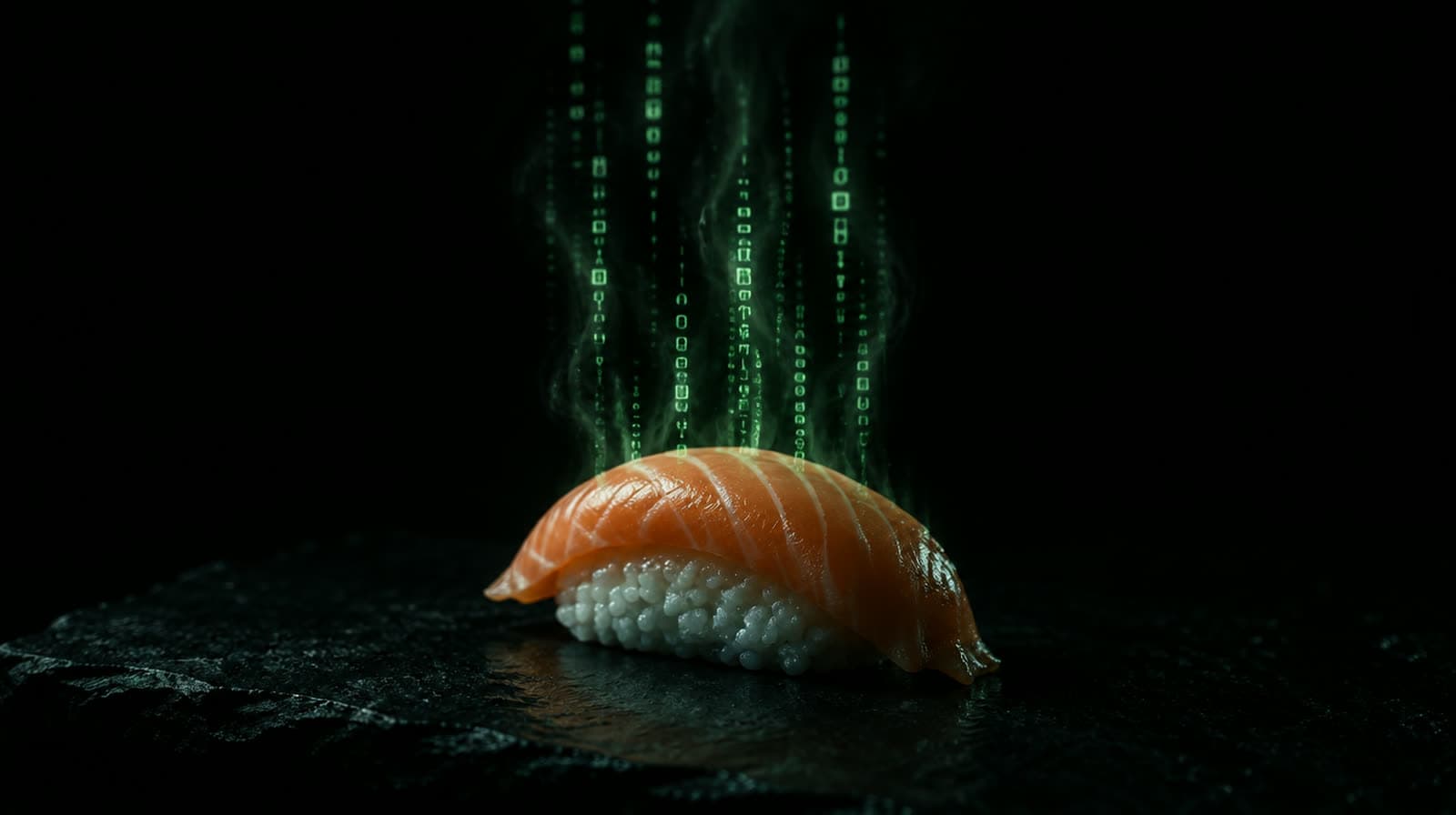
“The code is sushi recipes”
Half true. The digital rain was designed by production designer Simon Whiteley. His wife is Japanese, and he scanned characters out of her cookbooks and reworked them digitally.
But what ended up on screen isn't a readable recipe. The final version is a custom typeface of mirrored half-width katakana plus Latin letters and numerals. The source was a kitchen; the output is thoroughly stylised.
“Bullet time is slow motion”
It isn't. Slow motion means filming faster than you play back. Bullet time doesn't slow anything down: it freezes a single moment and moves the camera through it.
Around 120 still cameras were set on an arc around the actor — sources put it at 120 or 121 — with a motion-picture camera at each end. They fired in a precisely timed sequence, and each still became one frame. The gaps were filled with frame interpolation and optical flow, and the backgrounds were built with photogrammetry.
The work was led by John Gaeta and Manex Visual Effects, with Kim Libreri, Dan Piponi and George Borshukov among many others.
They couldn't build a camera that moved that fast. So they built a lot of cameras that didn't move at all, and wrote software to fill in the gaps.
It may be the most developer-shaped solution in the history of film.
“It's a film about Baudrillard”
Baudrillard disagreed. The Wachowskis made Jean Baudrillard's *Simulacra and Simulation* required reading for the cast. It's on screen, too: Neo keeps his hacker stash in a hollowed-out copy.
But Baudrillard said the film had nothing to do with his work. The disagreement is this: The Matrix assumes there's a real world underneath the simulation that you can wake up into. Baudrillard's argument was the opposite — there's no such floor; the simulation is all there is.
So the film's philosophy reading list was assigned, read, and rejected by its author. Anyone who has watched their library get used in a way the maintainer never intended will recognise the feeling.
“Will Smith turned it down”
True — and the reason is better than the legend. Offered Neo off the back of Men in Black, Smith made *Wild Wild West* instead.
His own account since: the pitch confused him, and he has said the Wachowskis did a bad job of explaining it. He's also said that in that version, Val Kilmer was being considered for Morpheus.
The Matrix grossed about $463.5 million worldwide. Wild Wild West grossed about $222.1 million. The gap is roughly $240 million.
Every developer has watched a brilliant idea die in a bad demo. This is the $240 million version.
“It's just an action film”
Its makers say otherwise. In 2020, Lilly Wachowski said the trilogy's original intention was a trans allegory: a story about the desire for transformation, told from a closeted point of view. The world, and the corporate world in particular, wasn't ready for it yet, she added.
One detail that didn't survive into the film: the character Switch was written as a man in the real world and a woman inside the Matrix. Both directors came out as trans after the trilogy was finished — Lana in 2010, Lilly in 2016.
“It won on its effects”
It won on four things. The Matrix took four Academy Awards: Film Editing, Sound, Sound Effects Editing and Visual Effects.
The visual effects win came in the same year as *Star Wars: Episode I*, which was expected to sweep the technical categories. That film cost around $115 million. The Matrix cost around $63 million.
Why this is on a developer's site
Because the lesson isn't about film. Every one of these stories was repeated until it became 'true', and every one of them was slightly off.
Codebases are full of the same folklore: “that function is slow”, “we can't touch that module”, “the cache fixes it”. The fix is the same in both places — go back to the source and read what's actually there.
That's the red pill. It's less dramatic than the film makes it look. Mostly it's reading.